Advantages of Cyber Security
Tuesday, September 22, 2026
TL;DR
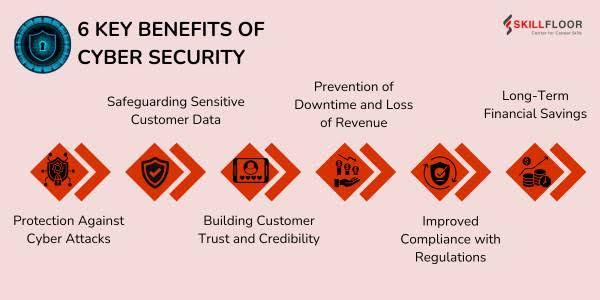
Cyber security reduces financial loss, protects reputation, ensures regulatory compliance, and enables business continuity. You'll learn the concrete business advantages, a simple framework you can apply, and three first actions to improve protection quickly.

By Jordan Reed, Cybersecurity & Technology Writer, Cybersecurity Research & Technology Content Specialist · Published · 6 min read
"Security is not a product, but a process." — Bruce Schneier, security technologist
Introduction
Cyber attacks quietly destroy value: they stop operations, leak customer data, and force expensive emergency fixes. Your organization pays more in reaction than it would to prevent the attack.
What This Doesn't Fix
Cyber security can't eliminate all risk or guarantee zero breaches; it reduces probability and impact. If your business has no digital assets, the return on investment may be smaller.
Which approach hurts less depends on your customer data volume, regulatory obligations, and how much downtime you can tolerate.
Cyber Security, Defined
Cyber security is the set of processes, technologies, and controls that protect networks, systems, and data from unauthorized access, damage, or disruption.
It includes prevention (hardening systems), detection (monitoring and alerts), and response (incident handling and recovery).
Why Cyber Security Is Worth Getting Right
Getting cyber security right protects revenue, preserves customer trust, and avoids regulatory fines.
Failing to act increases the chance of costly incidents and longer outages. Effective programs reduce incident impact and speed recovery, keeping operations running and legal risk lower.
Getting Cyber Security Working
Start with a risk-based program: identify critical assets, apply layered controls, measure detection and response time, then iterate.
Step 1 — Identify and Prioritise Critical Assets
List the systems and data whose compromise would cause the most harm, and rank them by business impact.
Map data flows, identify crown-jewel assets (customer records, payment systems, IP), and assign an owner for each asset so you focus limited budget where it matters.
Step 2 — Implement Layered Controls
Apply preventive controls first: strong authentication, patching, encryption, and network segmentation.
Use MFA (phishing-resistant where possible), enforce TLS 1.3 for transport, run EDR on endpoints, and isolate critical systems with VLANs or zero-trust microsegmentation.
Step 3 — Detect, Respond, and Improve
Deploy monitoring and an incident response plan so you find breaches fast and reduce damage.
Use a SIEM or managed detection (MSSP) to centralize logs, run regular tabletop exercises, and track mean time to detect and contain as your primary operational metrics.
Quick Comparison Table
This table helps you decide which cyber security investments match your organisation size and risk profile.
| Investment | Best For | Primary Benefit |
|---|---|---|
| Multi-Factor Authentication (MFA) | All organisations | Reduces account takeover risk significantly |
| Endpoint Detection & Response (EDR) | Mid-size and larger | Detects and isolates endpoint threats quickly |
| Security Information and Event Management (SIEM) | Enterprises or regulated firms | Centralized detection and compliance reporting |
| Managed Detection (MSSP) | Small teams without 24/7 staff | Provides expert monitoring without hiring |
Frequently Asked Questions
Does cyber security reduce business costs?
Yes, a mature program lowers expected loss by preventing incidents and cutting recovery costs.
Costs shift from emergency remediation to planned investments like monitoring, backups, and staff training.
How much should a small business spend on cyber security?
Start small: prioritize MFA, regular patching, backups, and an incident playbook; then scale investments to risk and revenue at stake.
Spending depends on data sensitivity and regulatory exposure; invest where business impact is highest.
Is compliance the same as security?
No. Compliance sets minimum controls, while security aims to reduce real risk beyond tick-box requirements.
Use standards like ISO/IEC 27001 or NIST CSF as a spine, but customize controls to your operational risks.
Can I outsource all security to a vendor?
Not entirely; outsourcing can provide capabilities, but you retain responsibility for oversight, configuration and incident decisions.
Vendors can deliver EDR, SIEM, or MSSP services, but governance and procurement choices remain your tasks.
Will cyber security stop ransomware?
Not always, but a layered program dramatically reduces the likelihood and impact of ransomware incidents.
Combine prevention (patching, EDR), backups with offline copies, and tested recovery plans to minimize damage.
Glossary
- MFAMulti-factor authentication—requires multiple proofs of identity before granting access.
- EDREndpoint Detection and Response—software that detects and contains endpoint threats.
- SIEMSecurity Information and Event Management—centralizes logs for detection and compliance.
- Zero TrustA model that assumes no implicit trust; every access request is verified.
- NIST CSFThe NIST Cybersecurity Framework—guidance for managing cyber risk, widely used for program design.
External Resources
- ISO/IEC 27001Standard for information security management systems.
- NIST Cybersecurity FrameworkGuidance for building a risk-based security program.
- OWASPApplication security resources and top vulnerabilities list.
Final Summary
This post established that cyber security is a risk-reduction program combining prevention, detection, and response; effective programs prioritize critical assets, deploy layered controls like MFA and EDR, and run detection with measurable MTTR goals.
The single thing to do first: open your asset inventory or create one and mark your top three crown-jewel assets—those are where you must focus controls immediately.
- Run an asset inventory and tag the top three critical systems or datasets.
- Enable MFA across all administrator and remote-access accounts.
- If you can't run inventory, start with mandatory MFA and verified offsite backups.
Real-World Example: Regional Healthcare Provider
Company: Regional healthcare provider (anonymous)
Approach: The provider prioritized patient-record systems, enforced network segmentation, rolled out MFA, and adopted a managed SIEM for 24/7 detection.
Results in Operational Terms
- Faster detection: internal alerts reduced investigation hand-off time from multi-day to same-day responses.
- Reduced operational disruption: segmentation confined incidents to non-critical networks, avoiding clinic-wide outages.
- Improved compliance posture: audit trails and centralized logs simplified reporting to regulators.
Cyber Security Checklist
Planning
- Create an asset inventory and classify data sensitivity.
- Choose a guiding standard (NIST CSF or ISO/IEC 27001) as your program spine.
Execution
- Enable MFA and enforce strong password policies (12+ characters minimum).
- Deploy endpoint protection (EDR), patch critical systems within defined SLAs, and segment the network.
- Implement backups with at least one offline copy retained for 30 days.
Track + Optimize
- Measure mean time to detect (MTTD) and mean time to contain (MTTC); set targets and improve them quarterly.
- Conduct quarterly tabletop exercises and annual penetration tests mapped to OWASP or relevant standards.
Written byJordan ReedCybersecurity & Technology Writer
Jordan Reed is a cybersecurity and technology writer focused on digital security, data privacy, and emerging security challenges. With 7+ years of experience in cybersecurity research and technology content, Jordan explains complex security concepts in practical, accessible language. His work covers cyber threats, data protection, privacy, AI security, and best practices for staying secure in an increasingly connected world.
Credentials: Cybersecurity Research & Technology Content Specialist, CompTIA Security+, Certified Information Privacy Professional (CIPP)
Expertise: Cybersecurity, Data Privacy, Digital Security, AI Security, Risk Management
7+ years of experience